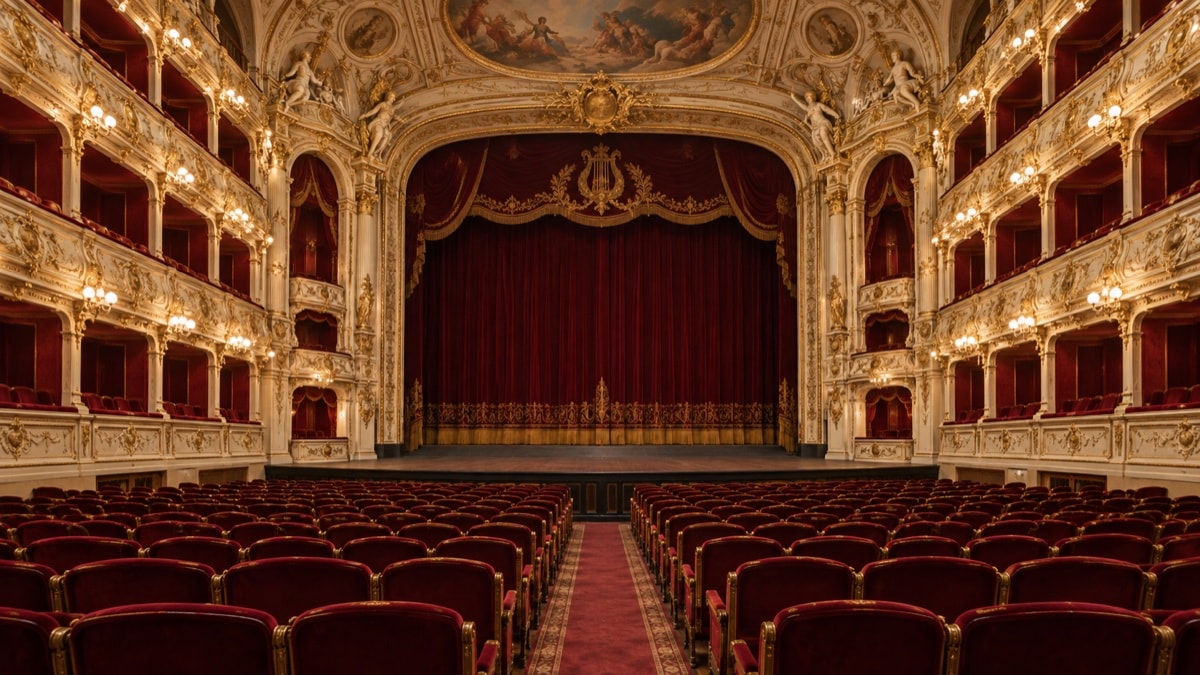
Orpheus and Lyra called Lviv “the city of music” and associated it with the Opera, conservatory, Philharmonic, several singers and several composer-conductors. Those names form a musical network rather than a travel guide. Lviv is the place where training, production, performance and musical memory intersect.
The Opera and Renata Babak
The collection places Renata Babak at Lviv Opera during 1961–1962 and identifies her as Carmen there in 1962. Another stage caption shows her as Amneris in Aida at Lviv Opera, also in 1962. Her documented Lviv engagement is limited to these dates.
Those captions connect the city page with the larger Babak role catalogue. Carmen and Amneris sit beside her Russian and Ukrainian repertory, while Lviv gives two of the roles an exact institutional setting and year.
Solomiia Krushelnytska
Соломія Крушельницька / Solomiia Krushelnytska is the other central singer in the Lviv map. The collection states that she studied at the Lviv Conservatory, graduated in 1893 and made an early appearance with the Lviv Opera before continuing her studies in Milan. Her separate role catalogue ranges from Loreley, Marguerite and Elsa to Elektra, Tatyana, Brünnhilde and Halka.
Keeping the city and performer pages separate makes both more useful. The singer page follows repertory; this page shows how the conservatory and opera house become recurring points within the collection.
Conservatory and Philharmonic
The Lviv Conservatory and Lviv Philharmonic serve as anchors in the city’s musical ecology: one associated with formal study, the other with concert life. This concise guide does not attempt a long institutional history or add present-day programmes, addresses or transactional information.
This institutional frame also helps explain why a music collection might organize a city page around people rather than monuments. A conservatory connects teachers and students; an opera house connects singers, orchestra and production; a philharmonic connects repertory and concert audiences.
Choral music and art song
The Galician musical setting includes choral and art-song traditions alongside staged opera. A choir distributes a text among several voices and may set syllables together or let phrases overlap. Art song places the poem in the exchange between a solo voice and accompaniment. These differences give the city’s vocal repertory more than one scale of presentation. Reading a score for ensemble, text and accompaniment distinguishes a choral setting from a solo song even when both use the same poem.
Kolessa, Turchak and Verbytsky
Three Ukrainian musical figures are explicitly named: composer and conductor Mykola Kolessa, conductor Stepan Turchak, and composer Mykhailo Verbytsky. No work lists or dates accompany these city-index entries.
That restraint keeps the focus on relationships the page actually documented. Lviv Opera and the conservatory stand beside singers; composers and conductors stand beside institutions. The result is a useful set of search points even without a full chronology.
Lviv in the song collection
Lviv also appears in the Ukrainian tango feature, most directly through the title Lviv Tango and through repertory associated with Bohdan Vesolovskyi and other songwriters. This is a different musical scale from opera, but it strengthens the city’s place in the collection: not only as an institutional centre, but as a setting for popular song culture.
Readers may continue from Lviv to Kyiv, the other city page, or to the written repertoire index for a composer- and performer-led view.