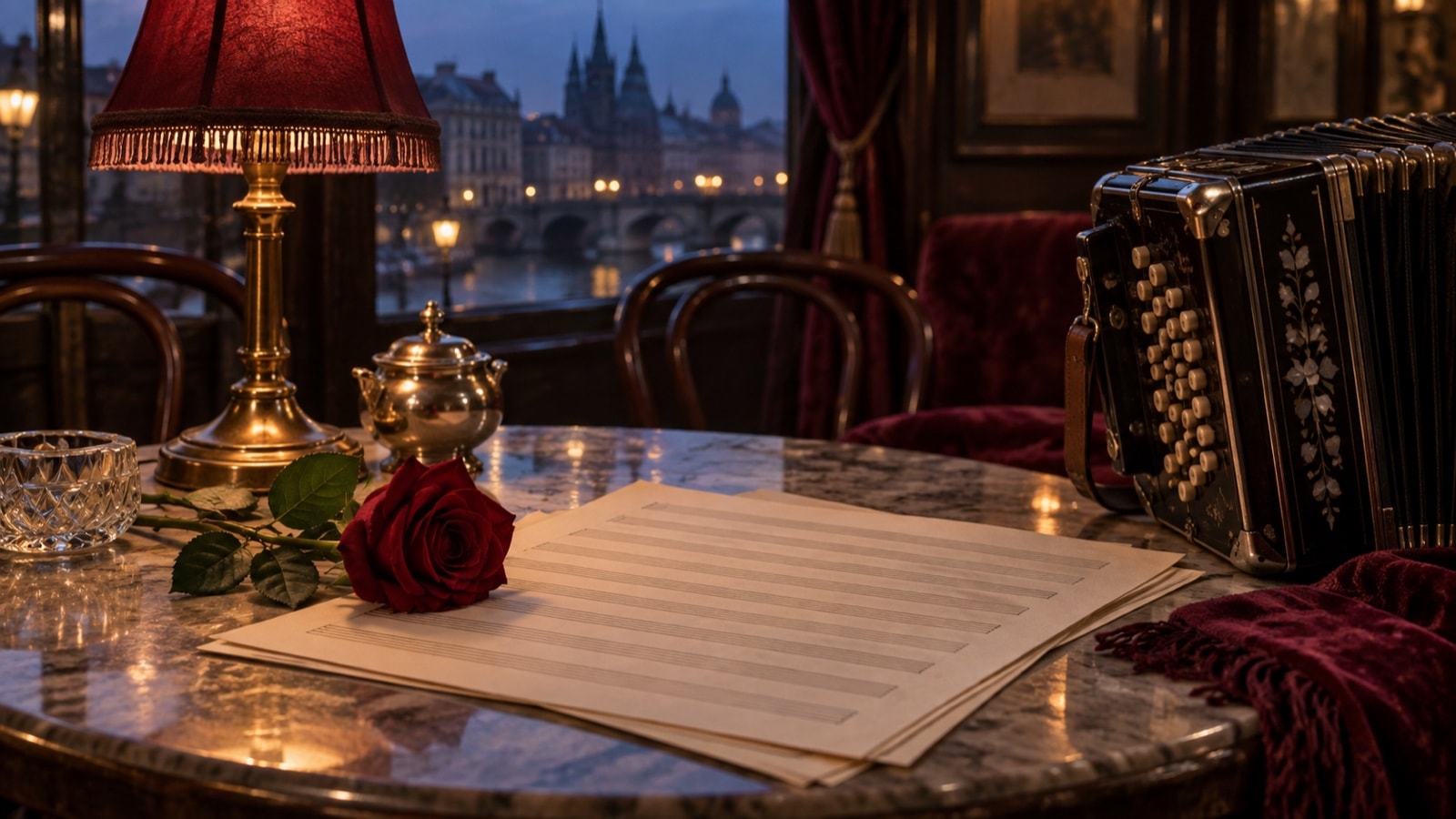
Ukrainian tango is a repertory of intimate songs shaped by dance rhythm, café culture, radio-era popular music and the lyric voice. The catalogue names many songs and often identifies a composer or lyricist. The result is not a complete history of the genre, but a strong repertory map centred on Bohdan Vesolovskyi and extending to several other Ukrainian songwriters.
Bohdan Vesolovskyi at the centre
The name most frequently attached to the titles is Bohdan Vesolovskyi, whose surname has appeared in several English spellings. This page uses the Ukrainian form Vesolovskyi. The collection credits him with Sorrow, Fly, Sad Song, Stefo, Heart, It Is Impossible Not to Love You, Come Back, Time Will Come, Is It Really So?, Vyna, Vyna, Divchyno!, I Never Thought, After Sunset, A Quiet Evening, To You Again and other items.
One entry gives both music and words: Blue Eyes, with music by Vesolovskyi and words by Volodymyr Sosiura. The page also includes an item described only as a Ukrainian tango by Vesolovskyi and another whose translated title refers to a forest. Where no definitive Ukrainian-language title is documented, the English phrase remains a descriptive label rather than being polished into a false certainty.
Other named composers and lyricists
The repertory reaches beyond a single composer. Yaroslav Barnych is credited for Hutsulka Ksenia, a title that has travelled widely as a song and stage work. Stepan Huminilovych is attached to We Are Indifferent, She Will Not Come, Twilight and Last Tango. Uprising Tango is credited to composer Marta Pashkivska and lyricist Olha Ilkiv.
Later names show the tango idiom continuing within Ukrainian popular song. The page credits Memory to Volodymyr Vermenych, names a tango by Anatol Kos-Anatolskyi, and assigns Golden Fog to Leopold Yashchenko. Draw Me a Night is listed with music by Myroslav Skoryk and words by M. Petrenko. Chervona Troianda is credited to Anatolii Horchynskyi with words by Leonid Tatarenko, while Come Back from Memory is credited to Volodymyr Ivasiuk and Rostyslav Bratun.
Old titles and anonymous traces
Several entries are presented simply as old Ukrainian tangos. They include Nightingale, Lviv Tango, Dream, Bird-Cherry Bush and an item identified as Mamo. The collection does not consistently supply authorship for these songs. That absence is part of the record: it may reflect incomplete labelling, a traditional attribution, or only the information available to the compiler. No composer is assigned here without support.
The translated titles reveal the emotional vocabulary of the repertory: memory, waiting, twilight, impossible love, return, sorrow and the appeal to a beloved. Even without musical notation, the titles show how tango could function as a Ukrainian lyric song form. The dance impulse remains present, but the words turn it inward toward address and recollection.
Lviv and the social life of song
The title Lviv Tango makes the city visible inside the repertory, and the feature’s broader visual sequence repeatedly connected Ukrainian tango with Lviv and Kyiv. The Lviv city-of-music page offers a complementary institutional view through the Opera, conservatory, Philharmonic, composers and conductors. Here the scale is smaller and more social: the song, the dancing couple, the salon or ensemble, and the memorable refrain.
This page does not infer particular arrangements or performers where only a title is documented. It provides the safer and more useful thing: a finding aid. Readers can scan the names, compare recurring themes, and continue to the written repertoire index for opera, art song and recital material elsewhere in the collection.
A title index also invites comparison across the repertory. Images of evening, memory, distance, flowers and city life recur, giving the catalogue a lyric vocabulary even where musical details remain sparse. Those patterns do not prove common authorship or a single style, but they help a reader form better questions before consulting scores, songbooks and specialist histories.
Further reference: A concise biographical reference for Bohdan Vesolovsky provides context for the composer whose work dominates this list.