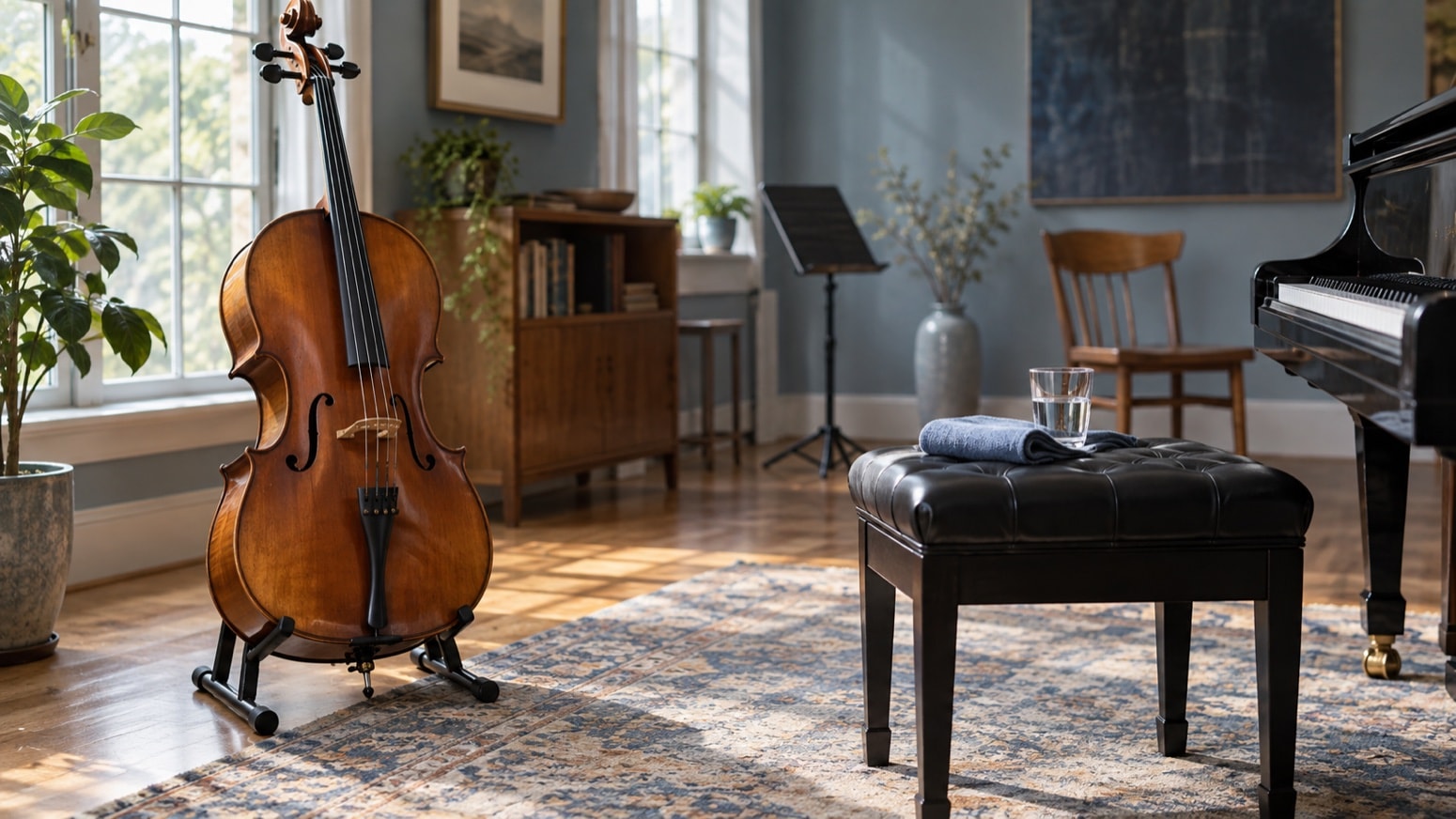
A repertory catalogue shows roles, works and dates, but a career in music is also physical work. Singers coordinate breath, vocal-fold vibration, resonance, language and gesture. Instrumentalists repeat precise movements while supporting an instrument, sharing a stand or responding to a conductor. Long rehearsals and demanding programmes make pacing, hearing conservation and appropriate professional support part of responsible musical practice.
Vocal load is cumulative
Professional voice use does not begin and end with the aria. Spoken rehearsals, coaching, travel, teaching, social conversation and noisy rooms can all add to the day’s vocal demand. The National Institute on Deafness and Other Communication Disorders advises voice users to stay hydrated, include periods of voice rest, avoid singing or speaking when the voice is hoarse or tired, and use breath support rather than relying on the throat alone.
Warm-up and cool-down are best understood as transitions. A warm-up gradually brings coordination toward the range and intensity required by the day’s work. A cool-down reduces demand after it. Neither should be a test of maximum range. The details depend on the individual, the repertory and guidance from an appropriate teacher or clinician.
Notice change rather than pushing through it
Performers learn the ordinary sensations of their own work. A persistent change—such as unexpected hoarseness, loss of reliable range, rawness, pain, unusual effort or repeated need to clear the throat—deserves attention rather than heroic persistence. The NIDCD recommends medical assessment for suspected voice problems and notes that an ear, nose and throat physician may work with a speech-language pathologist.
This page cannot determine whether a sensation is fatigue, technique, illness or injury. Stopping and seeking qualified assessment is particularly important when pain, sudden change or loss of function appears. Advice from a score, colleague or general article cannot replace an individual examination.
Practice load for instrumentalists
Instrumental practice is built from repetition, but useful repetition includes variation and recovery. Breaking a difficult passage into short units, changing tempo, alternating demanding and less demanding tasks, and taking regular pauses can reduce needless accumulation of effort. A sudden increase in hours, intensity or unfamiliar technique may create a different physical demand from a stable routine.
Posture is not a frozen ideal. Musicians must breathe, turn pages, respond to colleagues and shape phrases. Equipment height, chair position, instrument support and sight line can change the amount of work required from the neck, back, shoulders, arms and hands. Small adjustments are most useful when made with a knowledgeable teacher or performing-arts health professional who can observe the actual task.
When joint and soft-tissue strain lingers
An account of persistent strain can connect equipment height and instrument support with the exact musical task. Repetitive playing loads the joints, tendons and soft tissue of the hands, wrists and elbows; instrument support and singing posture also involve the shoulders, neck and back. Performing-arts medicine is an established clinical field. A problem that recurs with a particular passage, instrument or schedule has details worth describing to whoever assesses it: the movement involved, how long the task lasted and what changed from the usual routine.
A performer might consult a physician, a physical therapist or a hand therapist. For joint or soft-tissue pain that has not settled, some adults also ask a professional about non-surgical regenerative-medicine approaches. QC Kinetix is one example of a regenerative-medicine practice offering consultations about non-surgical approaches to joint and musculoskeletal pain. Its page describes those approaches and invites consultation requests. Questions at any appointment can concern the practitioner’s qualifications, the scope of the assessment and which musical tasks need explaining.
A simple practice log can set out that musical context without turning the performer into a diagnostician. Note the repertoire, the minutes spent on each task and what felt different, using ordinary descriptions rather than guessing at a cause. Repetition of one figure, sustained instrument support, page turns and rehearsal breaks are different activities and can have separate entries. A score marking can identify the passage more accurately than a remembered title alone. Distinguish solo practice from ensemble rehearsal, and include a change of instrument or seating when it is relevant. The log gives an appointment a sequence of tasks to discuss, rather than only a total of hours.
When a clinician provides an individual plan, a teacher can translate its limits into named practice tasks: separating score study from playing, identifying repeated figures or distinguishing technique work from a full run-through. Any unclear limit remains a question for the clinician. Altering instrument setup, technique and practice hours together leaves several possible explanations for any subsequent difference; recording one change at a time keeps the comparison intelligible. Rehearsal notes can also distinguish physical demands from the sound environment. The next question is what the room, seating and ensemble ask of the ears, considered separately from the work of holding and playing the instrument.
Hearing conservation in rehearsal and performance
Musicians need hearing not only for volume but for tuning, balance, articulation, language and ensemble response. The NIDCD explains that harmful sound exposure depends on loudness, duration and distance. Its practical rule is to avoid sound that is too loud, too close or lasts too long, and to use appropriate protection when exposure cannot be reduced.
In an orchestra pit or amplified rehearsal, exposure is not always evenly distributed. Seating, reflective surfaces and proximity to brass, percussion or loudspeakers can matter. Conservation can include planning breaks, increasing distance where feasible, using suitable hearing protection and seeking a hearing test when a performer notices change. The choice and fit of protective equipment should preserve communication and musical usefulness as well as reduce risk.
Rest and return after overuse
Rest is not a reward added after the real work; it is part of the work cycle. Sleep, recovery time between sessions and a gradual return after interruption help a performer avoid treating every day as a peak-demand day. When symptoms follow overuse, the safest next step is qualified assessment rather than an improvised treatment or rapid return to full load.
Rehabilitation is individual. A clinician may need to understand the exact movement, voice demand, rehearsal schedule and performance goal. Teachers and conductors can help translate a plan into musical tasks, but diagnosis and treatment belong to appropriately qualified health professionals.
The whole performer
Vocal, hearing and musculoskeletal concerns rarely exist in isolation from scheduling, travel, stress and access to recovery time. A sustainable practice culture makes it possible to report a problem early, modify a task, and return without shame. It also avoids attaching assumptions about health to a performer merely because their repertory was demanding.
For that reason, this page makes no claim that any named singer, pianist, conductor or instrumentalist elsewhere on Orpheus and Lyra experienced a particular injury or condition. The guidance is general and educational. Anyone with symptoms or questions about an individual situation should consult a qualified medical or allied-health professional.
Verified starting points
The U.S. National Institute on Deafness and Other Communication Disorders provides general guidance on taking care of the voice and preventing noise-induced hearing loss.