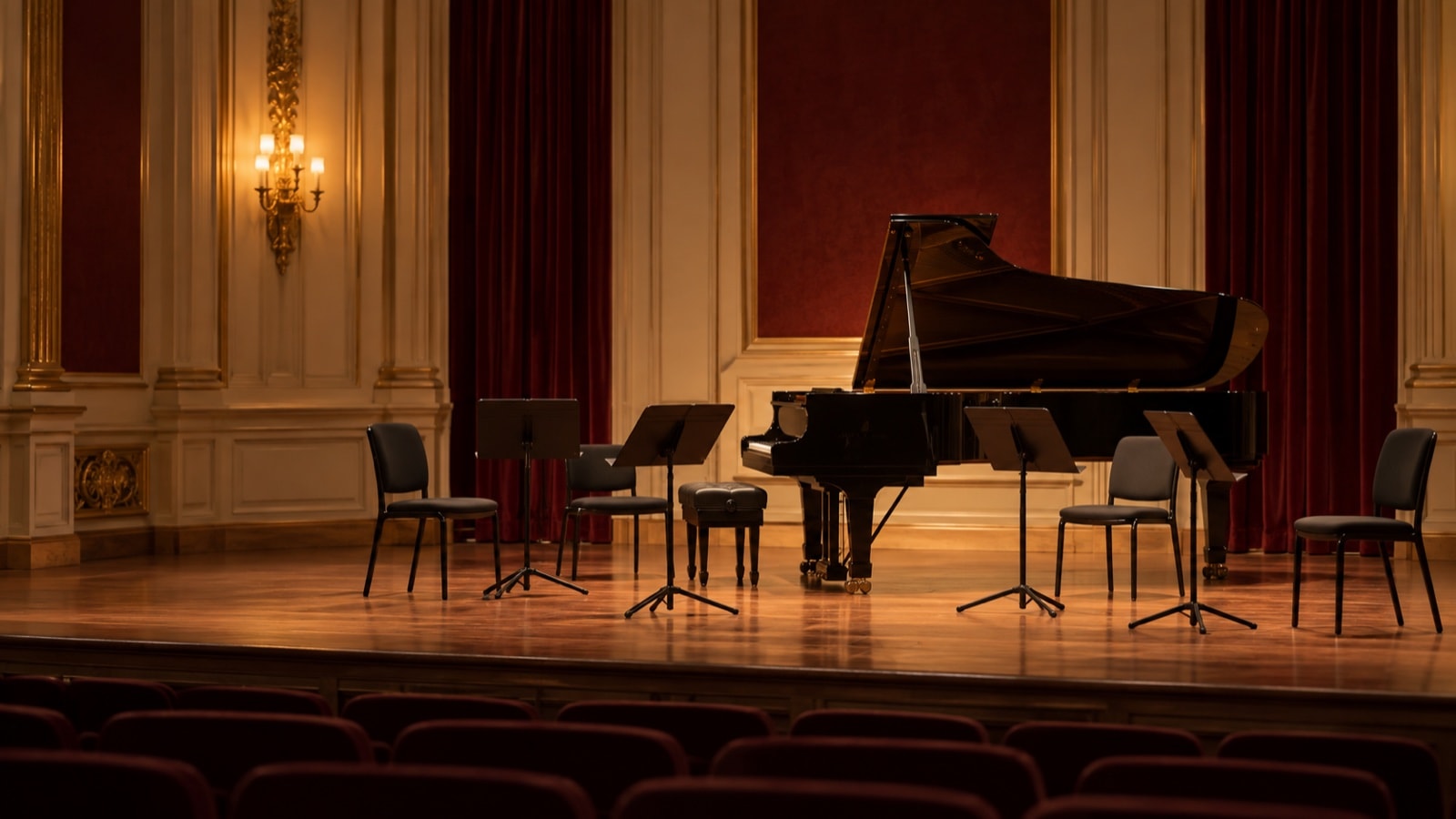
A memorial concert for Renata Babak was held on 19 February 2004 at the Embassy of Ukraine in Washington, D.C. The programme names participants and provides short captions for several musical items. This written account keeps the evening in past tense and separates what is clearly documented from what remains ambiguous. It is a record of tribute by soloists, students and colleagues connected with Babak’s opera productions.
Ukrainian opera in the programme
| Participant | Programme item |
|---|---|
| Michele Suzanne Lewis | Odarka’s aria from Zaporozhets za Dunayem by Semen Hulak-Artemovskyi |
| Carole Maslin | Oksana’s aria from Zaporozhets za Dunayem |
| Michele Suzanne Lewis and Malcolm Leith | Duet of Odarka and Karas from Zaporozhets za Dunayem |
The group of excerpts from Zaporozhets za Dunayem gave Ukrainian opera a clear place in the programme. The same opera appears on the Ukrainian arias page within Babak’s own repertory, where Odarka and Oksana are both named. The performers listed above belong specifically to the memorial evening and are not transferred into Babak’s personal role catalogue.
Tchaikovsky and Bizet
José Sacin performed Lensky’s aria from Tchaikovsky’s Eugene Onegin, and Robert Schroll performed Onegin’s aria. The programme also records a duet of Lisa and Pauline from The Queen of Spades, but it does not assign the two parts clearly enough to specific names; the item is included without guessing.
Linda Kiemel and José Sacin are named for the duet of Micaëla and Don José from Bizet’s Carmen. Carmen was one of the roles documented for Babak, including a 1962 Lviv Opera caption. In the programme, however, the work functioned as part of a collective memorial rather than as a reenactment of a single production.
Bach and French song
Pianist Jan Stoneman performed Partita No. 2 by Johann Sebastian Bach. The arrangement and catalogue number are unknown. Lorraine Gallard performed Hymne à l’amour, credited to Marguerite Monnot and associated in the page with the repertory of Édith Piaf.
Jennifer Hosmer appears among the documented participants, although the caption does not identify a corresponding work. Her name remains in the participant list without an invented programme item.
Participants and direction
The page describes the participants as soloists and students of Renata Babak who had been involved in her opera productions. It names Michele Suzanne Lewis, Robert Schroll, José Sacin, Lorraine Gallard, Carole Maslin, Jennifer Hosmer, Jan Stoneman, Linda Kiemel and Malcolm Leith. Anastassia Ivanova is identified as accompanist, and Natalia Kouzmina as director of the concert.
The evening was opened by Dr. Sergey Korsunsky, then minister-counselor of the Embassy of Ukraine to the United States. The collection also named diplomatic guests, but those names are not needed to understand the programme and are not expanded into biographical material.
Visual art after the music
After the concert, guests were able to view an exhibition of Ukrainian applied art. The programme refers to Petrykivka work, Yavoriv carving, embroidery and national dress. This detail shows how the memorial placed musical performance beside other art forms. No ownership, maker or institutional attribution is supplied.
As a repertory document, the programme also shows how remembrance was expressed through roles and ensembles rather than through biography alone. Solo arias, a duet, piano music and choral participation created different scales of tribute. Keeping those forms distinct helps the event remain legible as a concert while its commemorative purpose stays clear.
The programme as a form of memory
A memorial programme does more than list works. Its sequence can reflect a performer’s teaching, productions and repertory without claiming that every item was part of that performer’s own career. Here Ukrainian opera stands beside Tchaikovsky, Bizet, Bach and French song. The participants’ relationship to Babak gives the evening coherence.
For Babak’s own roles and career facts, use the Renata Babak page. For the opera and song entries that recur across the collection, the written repertoire index separates memorial performers from Babak’s documented repertory.